
Scale your Venture
invstt offers a chance to find the right investors to back your idea.

1-10
Singapore , 2019
Singapore

Today-2024: There are different scales for growing cells. For small scale cell growth, cells are grown in petri-dishes or flasks, where the number of cells are limited by the surface area of the vessel. However, when companies want to scale-up cell growth, cells are grown for industry applications, cells are grown in bioreactors. Within bioreactors, cells attach on tiny beads call microcarriers. These microcarriers provides a large surface area for the cells to grow onto, within the bioreactor. The global microcarriers market in terms of revenue was estimated to be worth $2.0 billion in 2023 and is poised to reach $3.3 billion by 2028, growing at a CAGR of 10.0% from 2023 to 2028. Cellivate has been getting repeated orders for our microcarriers. Our microcarriers perform on par or better (depending on application) than pharma grade microcarriers. Our customers choose us because we charge 1/3 the price of the industry leaders. Moving Forward-2025: While our other microcarriers add value to the cell growth industry, our cell-based serum product will be a game-changer within the cell culture industry; this product will 100x Cellivate’s value. Fetal bovine serum (FBS) is the gold standard in growing cells. It is derived from the blood of fetal cows. The global FBS market size was valued at USD 1.57 billion in 2022 and is expected to grow at a compound annual growth rate (CAGR) of 14.1% from 2023 to 2030. It is also the most expensive component and our product replaces this
Cellivate Technologies is a spin-off from the National University of Singapore. We develop and commercialize proprietary products and technologies that solve the bottlenecks faced by cell based companies at different stages of the value chain. Our solutions allow them to accelerate and solidify their processes at lower costs and are translatable to different cell culture applications. As such, we have early traction in the cultivated meat, cosmetics, and leather fields. Over the last year, Cellivate has begun generating recurring revenue. We have orders and interests far exceeding our production capacity. Therefore, we are looking to scale up our production to service the orders we have and to reach a wider customer base.
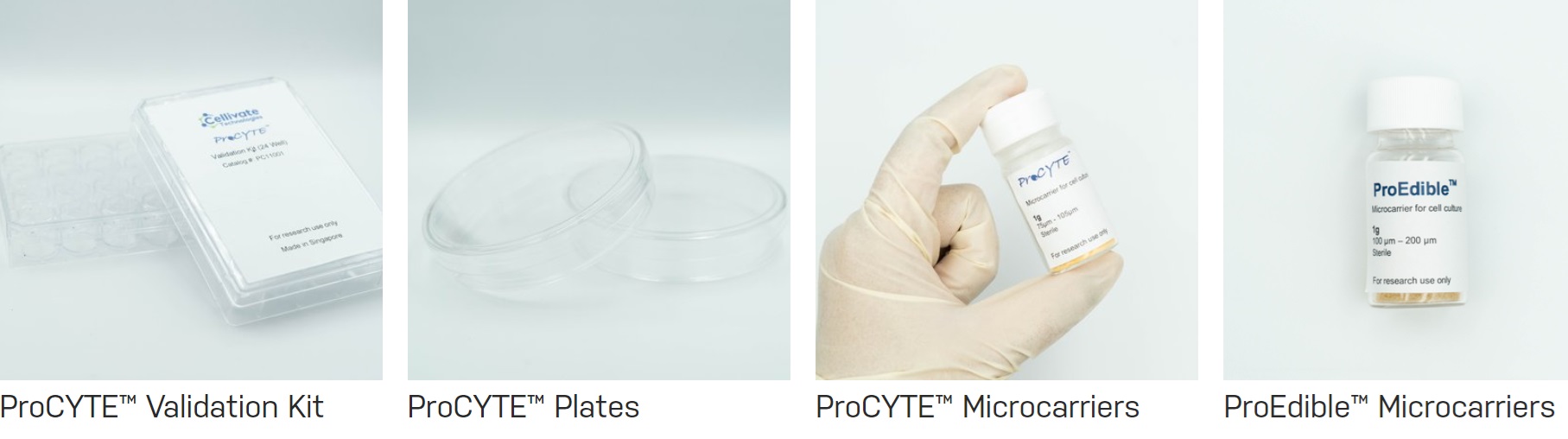


Cellivate Technologies is a B-2-B company. As such, we do not directly face the mass consumer market; rather, we provide products to other businesses that may face the mass consumer market. In the first phase, Cellivate sells its products to help companies grow cells more efficiently, for their particular application. In the second phase, in addition to selling products, Cellivate will licence its technology and provide technical services to companies that require Cellivate’s expertise to grow cells. Cellivate Technologies has two types of product offerings: Standard Products and Customised Products. Our standard products are for customers doing cell culture at different scales, depending on their need; as they are ‘standard’, they have a fixed price. Our customised products are tailored to specific customers; as such they will naturally be at a premium.
Australia & New Zealand (Oceania), North America, Southeast Asia, South Asia
Marketplace
B2B
*ThermoFisher *Multus Media *Cytiva

Founder / CEO


Technical Advisor and Co-Founder
Tell us a bit about how founding team knows each other.
I (Viknish) was postdoctoral student of Prof Venkatesan. We co-invented a tech and decided to spinout Cellivate Technologies. Apart from us, we have Admin and other technical staff.
Why did you decide to start this company?
1) We had a novel tech that could solve an unmet need faced by companies using cells 2) The market size was large
Are all the founders full-time on this project?
No
Set up your account as an Investor.
Already have an account? Login Nowinvstt offers a chance to find the right investors to back your idea.
Login and get access to a authentic community of investors, founders and professionals.